
Our vision for a rat free capital city
We’re making Wellington the world’s first predator free capital city, a place where our native wildlife and communities can thrive.
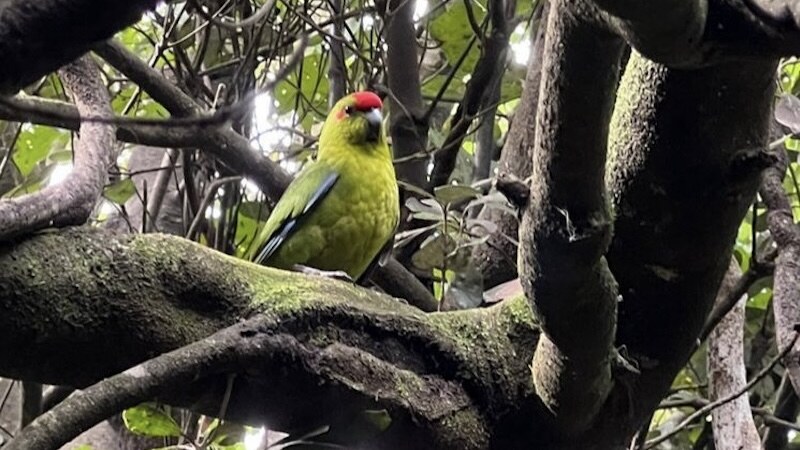 A kākāriki spotted on Miramar Peninsula for the first time in living memory.This ambitious project involves thousands – households, community groups and organisations – all working together to remove every single rat, possum, stoat and weasel from the Wellington area.
Our project is special because it moves beyond typical conservation with fences and offshore islands. Our work sees our precious native taonga living among a city where 212,000 people live, work and play, every day.
Learn about the impact of our project.
Our plan to make Wellington predator free
Our project covers 30,000 ha and around 70,000 households, stretching from Miramar Peninsula over to Mākara and along the SH1 motorway up to Porirua.
Across this area there are nearly 50 community trapping groups – that’s one for every suburb in Wellington and most of the reserves in between. Some of these volunteer groups were active long before our project began. We are already seeing wildlife bouncing back thanks to the efforts of trappers and the spill-over from Zealandia Te Māra a Tāne.
Our project works with households, businesses and landowners to create an intensive network that removes rats. We are working through five phases:
- Miramar Peninsula (Phase 1): Phase 1 is complete! We started here as it’s been possum free since 2006 and as a peninsula it’s easier to defend against returning rats and stoats.
- Island Bay to CBD (Phase 2): Our current phase includes sections of the Wellington town belt, city centre and suburbs. We are installing and checking traps and bait stations suburb-by-suburb. Residents in Phase 2, you can sign up now!
- Phases 3, 4 and 5: These phases involve the central city and more rural terrain, with a mix of farmland, wind farms and regenerating forest. In these phases we will work closely with our friends at Capital Kiwi and coordinate with Porirua City’s control efforts as we near the upper border.
Check out our FAQs for more info about our project.
Explore our dashboard showing our progress making Wellington predator free.
 The boundaries for the five phases of our project
Our reasons for running this world-first project
Removing rats, stoats, weasels and possums will give our unique wildlife a fighting chance to survive. Aotearoa is home to 80,000 species that live nowhere else. But we also have the highest proportion of threatened wildlife. Introduced predators kill an estimated 68,000 native birds every night. Millions of years of geographical isolation made our taonga vulnerable to predatory mammals.
Our project is working to solve the urban piece of the national Predator Free 2050 puzzle.
Predator free projects have made huge differences in our city. In the 1980s, only around 10 pairs of tūī and kererū remained in Wellington. Today, Wellington is bucking global trends and rewilding in front of our eyes with kākā and other native birds a daily sight for our tamariki! As well as more wildlife, we’re creating a better city for people, increasing wellbeing and building communities. We’re also lowering the costs of long-term predator control.