
Government invests $5.5 million to accelerate Wellington’s predator-free future
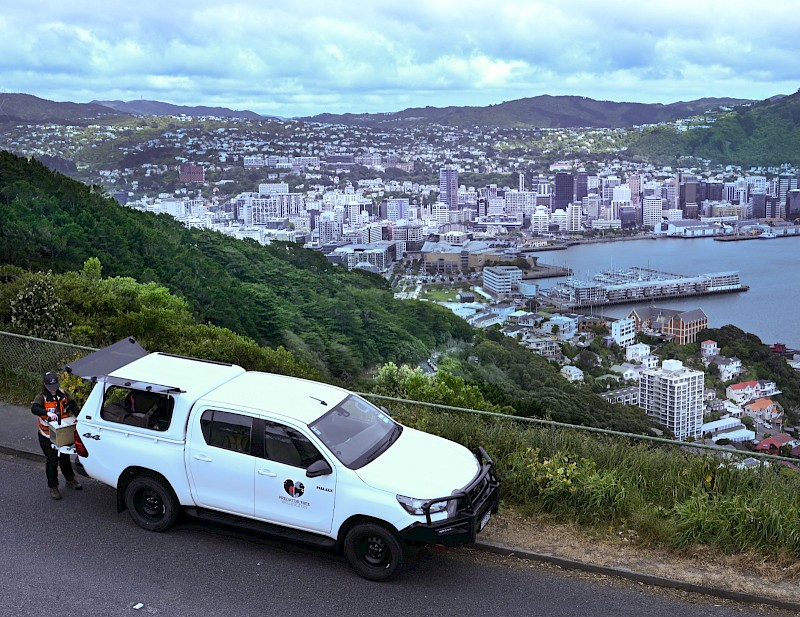 A Predator Free Wellington ute and field operator near the summit of Mt VictoriaThe Government’s commitment to Predator Free Wellington is good news for the Capital.
The promise of $5.5m over five years, delivered today by Conservation Minister Tama Potaka, provides the backing needed to make Wellington the world’s first predator-free capital city by 2030 and create a replicable blueprint for urban centres across New Zealand.
This investment is a significant vote of confidence in the Predator Free Wellington model, according to Chair Tim Pankhurst.
“We know money is tight and sharply contested and we are delighted the Government, through the Department of Conservation, has recognised the worth of our vision to return the dawn chorus to the city,” he said.
Central government funding now makes up around 37.5% of our annual programme budget – a significant increase and a strong vote of confidence in what Wellington has achieved so far.
To complete the job, we will build on this momentum by partnering with funders, businesses and the wider community. In the coming weeks, we’ll be sharing more ways Wellingtonians can be part of making our city predator free.
“Wellington is one of the few cities in the world where biodiversity is actually increasing. That is a precious thing and Wellington sure needs some successes,” Tim exaplained.
“Wellingtonians are loving waking to the sound of tūī and the sight of kākā as we eliminate rats, mustelids and possums that destroy our native wildlife.
“Hundreds of volunteers are involved in trapping and surveillance, providing a huge boost to our paid staff, and we have the support of Wellington City Council, Greater Wellington and the philanthropic NEXT Foundation in particular.
“This funding provides the long-term certainty Predator Free Wellington needs to scale the project across the whole city,” Pankhurst said.
Predator Free Wellington Project Director James Willcocks says five years of secure funding changes what’s possible.
“We can now plan ahead and keep driving the efficiencies that make this project more effective with every phase. We’re continually refining our methods, and that’s what will carry us to the finish line,” James said.
“The funding will accelerate Phase 2, currently underway across 14 suburbs from Island Bay to CBD. This phase takes us into uncharted territory: making Te Nukuao Wellington Zoo rat-free. We’re also tackling dense urban landscapes like Hataitai, the green belt, and Island Bay and Ōwhiro Bay – complex environments that will test and prove our urban predator control model.
Phase 3 will create a protective halo around Zealandia, expanding the sanctuary’s halo footprint fivefold – from 225 hectares to encompass Te Kopahou Reserve’s 1,200 hectares.
“As our work expands into Capital Kiwi’s territory, the potential for synergy grows. Imagine Capital Kiwi, Zealandia, and Predator Free Wellington’s efforts converging – creating an interconnected predator-free landscape where kiwi and all of our most precious native taonga (native wildlife) can thrive across Wellington,” Willcocks said.
As New Zealand’s urban demonstration project, Predator Free Wellington plays a central role in the national Predator Free programme, developing and refining the tools, technology and community approaches that other cities can adopt.
Willcocks says Government investment is essential, but so is continued collective effort.
“This is a whole-community project. Councils, businesses, philanthropists and Wellingtonians all play a role. This funding strengthens the foundation – now we can keep building.”
Posted: 25 March 2026