
Camera shy rats keep low profile in Miramar
We know they’re out there somewhere but the rat population of Miramar is proving particularly elusive, or perhaps just plain camera shy.
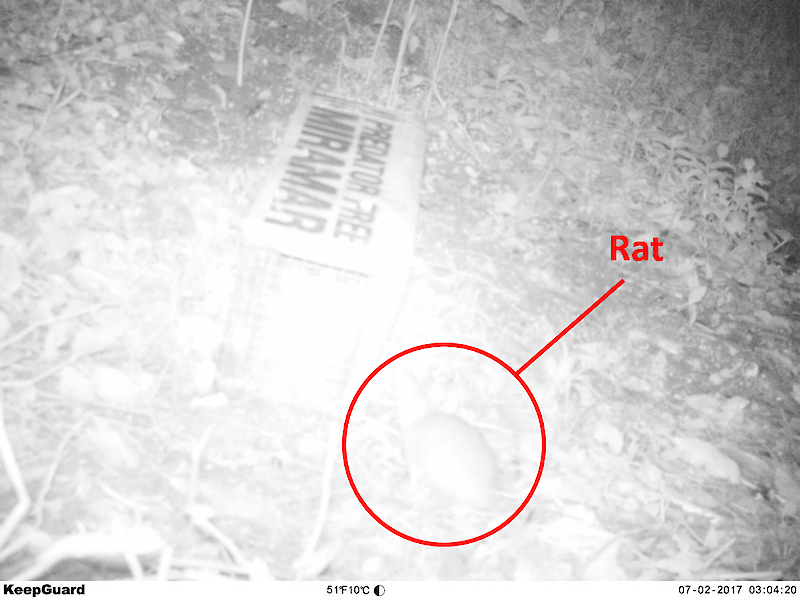 That’s what Predator Free Wellington found recently when they set up ‘Operation Ratcam’ to identify where rats in Miramar gather and feed.
Predator Free Wellington is an ambitious project which aims to increase native birdlife by making Wellington City predator free. It is supported by Wellington City Council, the Greater Wellington Regional Council and NEXT Foundation.
As part of the project’s initial scoping, “backyard” cameras were deployed to identify where rats gather and feed; information Predator Free Wellington will use to better target the pests through backyard trapping. Operation Ratcam involved Greater Wellington Regional Council sending out ten camera traps with citizen scientists to investigate.
The cameras were placed in a number of locations in Miramar including commercial premises, outside restaurants and residential backyards and then orientated to capture images close to compost bins, rubbish bins and dumpsters.
The most striking result was how few rats and mice were seen over the three weeks the cameras were out. Project Director James Willcocks says “Although we didn’t capture a lot of rodent images with this trial we do know they are out there — albeit a little camera shy. We have good reports of traps located close to compost heaps and other food sources delivering results so we encourage community trappers to keep up the great work!”
The project’s initial focus is on eradicating predators from the Miramar Peninsula before moving into other Wellington suburbs. Predator Free Wellington has now deployed its first tranche of 320 traps to local trapping groups, Predator Free Miramar and Predator Free Seatoun. And despite the rats avoiding the cameras, they are finding the traps. “Since Predator Free Miramar launched 3 weeks ago, we have 189 households with traps and we’ve caught 87 rats and mice. We know the rats are out there, and as we ramp up I have no doubt we’ll be catching hundreds. It’s great we’ve been able to get started with the support of free traps from Predator Free Wellington,” said Dan Henry, Coordinator for Predator Free Miramar.
The role of the Predator Free Wellington project is not to take over what community groups are doing – far from it, says James. “We want to support the community groups and help inspire more predator free community groups to get started. This is not about Predator Free Wellington doing it all. Our success depends on communities getting involved, and Predator Free Wellington will support these groups with traps to get more Wellingtonians involved in backyard trapping.”
Anyone in Miramar or Seatoun who wants to get involved should register their interest with their local group. Email [Enable JavaScript to view protected content] or [Enable JavaScript to view protected content]
Posted: 7 September 2017