
Gateway students building a strong conservation future
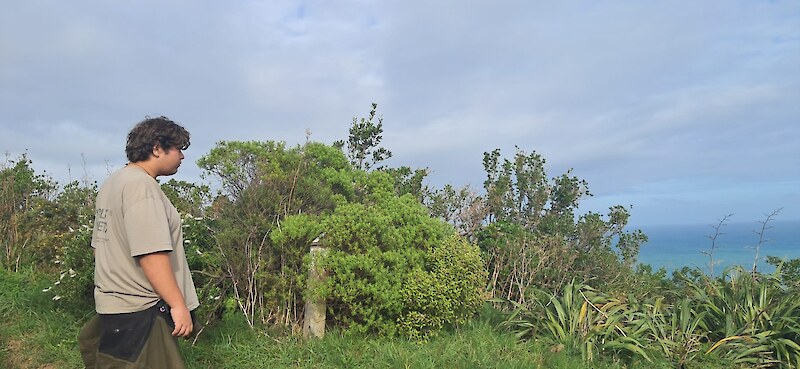 TJ on a lunch break in coastal MiramarThe future of conservation is in great hands. Predator Free Wellington had the pleasure of working with TJ and Zeke, two hard-working Gateway students from Taita College. In their final years of high school, they got stuck in and impressed the PFW team.
‘Every day we’re in the field, we’re learning a ton of stuff,’ explains TJ. ‘It’s cool to go down the rabbit hole – there’s so much knowledge. We’re both trying to do the best we can.’
TJ and Zeke study at Taita College and are involved in the Te Ahi Kā programme that cares for a neighbouring wetland. With more than 90% of native wetlands being permanently changed or removed, the boys were driven to care for this important habitat.
TJ describes the holistic approach to the wetland work. ‘There’s a sense of pride around the restoration. We were weeding, planting, removing rubbish, and monitoring the water. We were doing pretty much everything but trapping.’
The project was almost a victim of its own success, notes Zeke. ‘We restored this special place for our native birds, but we also created great habitat for rats and possums.’
Working to protect our native wildlife was how they came to connect with our project. The school had a few old traps but reaching out to other projects helped improve things. Thanks to Greater Wellington Regional Council and Predator Free Wainuiomata, the school received traps and advice. A few Youtube tutorials also helped them learn how to use everything.
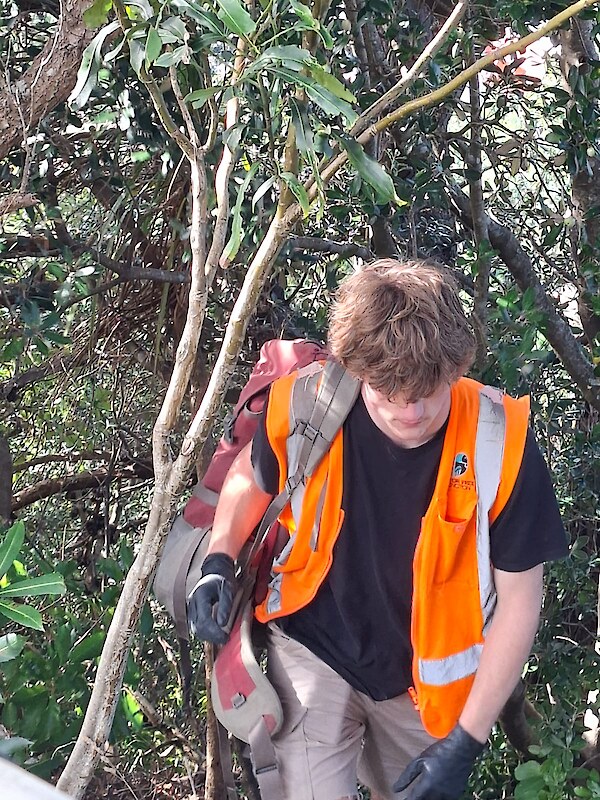 Zeke heading to another trapThey’d got a start but wanted to improve. ‘We took it on ourselves to go out and learn more,’ says TJ. ‘And one of those steps has been through Gateway and Predator Free Wellington.’
It’s been a crash course learning the many tricks of the PFW field team. Zeke says the biggest thing he’s learnt is ‘about where rats live and how they behave in the bush. I took that back to our Te Ahi Kā traplines because I knew about where rats run, the tunnels they make, where they go, how they climb trees. We ended up catching more rats.’
They’ve also learnt how to use their school’s limited resources more effectively. ‘We can’t waste our time by placing a trap in the middle of an open field,ʻ explains TJ. ‘We now use our traps well and teach other students so they can continue the mahi. We have to care for our fragile ecosystem.’
Field supervisor Jay is impressed with the young men and how they’ve quickly become part of the team: ‘They’ve been a real asset to our organisation. They come in and work really hard for long days, travelling from the Hutt to our depot for an 8am start.’
They also came in during their school holidays!
‘I think they should be really heralded for what they’re doing,’ says Jay.
What’s next for TJ and Zeke? ‘Racking up as much experience and variety of work as possible, and building good relationships in the community,’ says Zeke. ‘The idea is to work in some branch of conservation.’
TJ agrees: ‘The great thing about conservation is that there isn’t just one thing. You can jump across from trapping to planting to animal care; there are roles with Capital Kiwi, Zealandia or DOC.’
Mauri mahi, mauri ora – do the mahi, get the treats. For TJ and Zeke, this means great connections in the conservation sector, a more resilient wetland and protecting our native wildlife.
Posted: 27 May 2026