
How Wero helps make our city predator free
Specially trained detector dogs are essential in our work to find and remove predators. We caught up with Brad and Wero as they checked for stoats on a recent visit to Wellington.
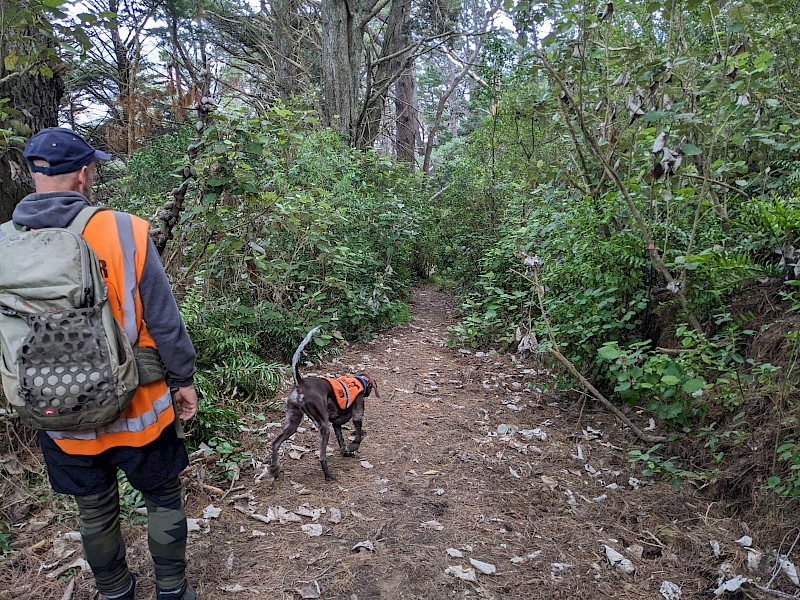 Brad and Wero working in Mt VictoriaBrad and Wero live near Waitangi but they’re seldom home. Instead they often find themselves on sub-Antarctic islands, running around Waiheke or exploring remote parts of Fiordland. Brad is a former pig hunter, conservationist and dog handler. Wero is a German Shorthaired Pointer and a very good boy who loves playing with his ball. He is also Aotearoa’s only stoat poo detection dog.
They’re in Wellington for a routine stoat check and have another set of hazards to watch out for. Auckland Island is home to huge sea lions. It was hard to sleep on Chalky Island due to all the kākāpō booming. Around Mt Victoria and Miramar they have to watch out for cars on the road, broken glass and other dogs.
Working together
Brad trained Wero and the two share information on the job. Brad uses calls and hand signals and Wero’s tail and behaviour show when he’s found something. ‘He’s such a playful dog and a quick learner,’ Brad explains. ‘He must also be part kangaroo the way he jumps around.’ They have lived and worked together for five years. As a reward for his hard work and when he detects stoats, Wero gets to play with a colourful ball.
Brad chose the name Wero to recognise the challenge of removing predators from the country by 2050. Stoats are clever, elusive animals that are hard to catch. A male was detected on Fiordland’s predator free Chalky Island in 2023. Even though Wero found its scat and home range, it took eight months to trap.
Helping Wellington become predator free
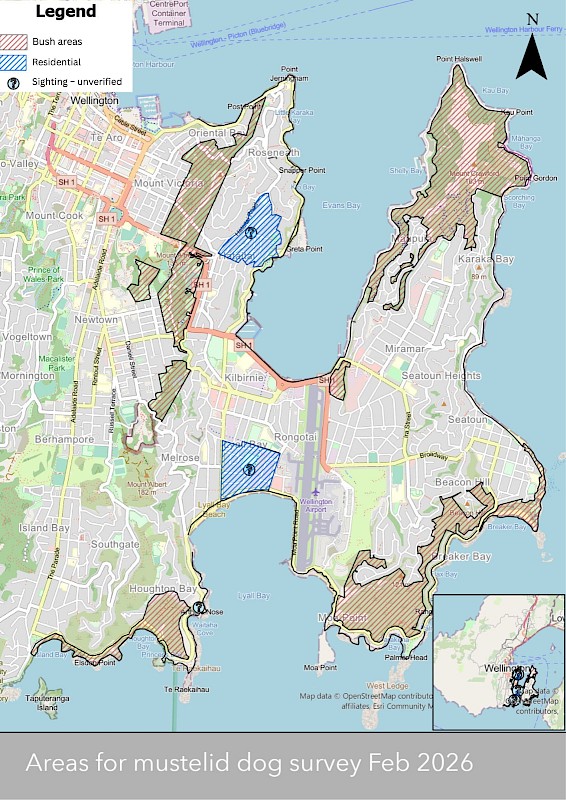 A map showing the areas Brad and Wero checked. It includes unverified public sightings – no signs of stoats were found at these sites.The pair visit Wellington periodically and play an important part in our biosecurity monitoring work. We rely on reports from the public, cameras, bait stations, traps, chew cards and tracking dogs to protect areas we’ve cleared. Wero and Brad surveyed bush areas and coasts around Miramar, Lyall Bay, Mount Vic and Houghton Bay. After covering a lot of territory, they didn’t find any signs of stoats.
We are always ready to deal with stoats though and have seen a recent jump in sightings and catches across other parts of the city. In our Phase 2 buffer of traps (covering green spaces like Prince of Wales Park, Tawatawa Reserve, etc), volunteers caught five stoats and weasels in the last months of 2025, after having caught one stoat in the year prior!
When we catch stoats, we genetically test them to understand more about them. This was how we knew the stoat caught on Miramar Peninsula in July 2024 had travelled all the way from near Mākara Beach.
Though there’s nothing found after some long days, Wero still has plenty of energy and excitement to leap around and play with his ball.
Posted: 13 February 2026