
My Hometown's on Track to Eradicate Rats. Could NYC Do the Same?
This article was written by Jessy Edwards for Hell Gate, published 24 July 2026.
In 2016, the government of New Zealand, where I’m from, announced a lofty goal: to make the island nation “predator free” by 2050. Photo by Tim Sutton
The plan was to eradicate all rats, plus possums, weasels, stoats (and now, feral cats), by mid-century and bring the country back, more or less, to a precolonial state of bird supremacy.
New Zealand broke away from the supercontinent of Gondwana before walking mammals evolved, so its only native mammals are bats and seals. The country’s birds thus evolved to be overly chill, and particularly vulnerable to introduced predators, who munched through much of the native biodiversity, bringing many species—including our namesake, the kiwi—to the brink of extinction.
I hadn’t heard much about Predator Free 2050 since I moved to New York City in 2016. The government of New Zealand changed, COVID-19 hit, the leadership changed again. But, at the end of March, the government made its first public strategy update since the ambitious goal was first announced: My hometown of Wellington was on track to be the first predator-free city in the country, and the first predator-free capital city in the world, within the next decade. This week, I found out that my home neighborhood, Miramar Peninsula (where much of “Lord of the Rings” was produced), has already totally eradicated rats.
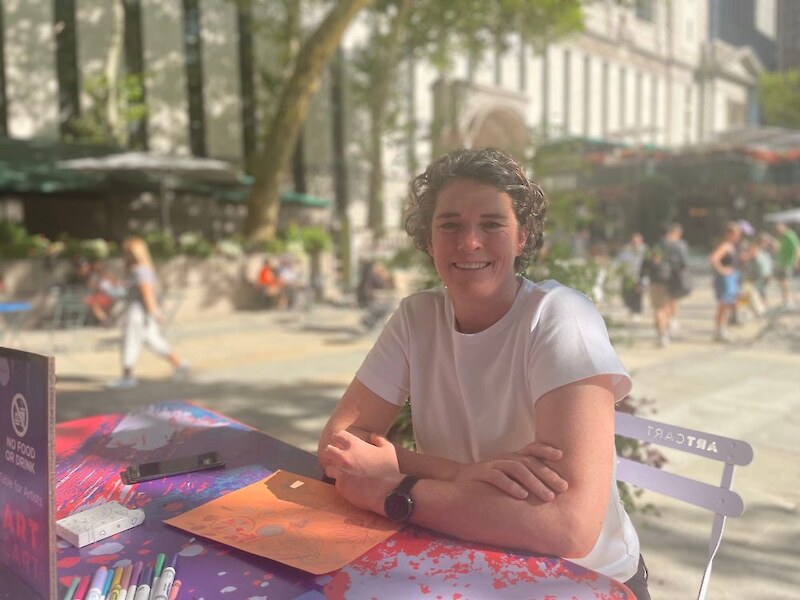 Zealandia CEO Danielle Shanahan in Bryant Park. (Hell Gate)“Miramar—this beautiful part of Aotearoa [New Zealand]—is now what we think is the world’s first rat-free urban environment,” Danielle Shanahan, CEO of the Wellington urban ecosanctuary Zealandia, told me in the also once-ratty Bryant Park this week. She’s one of the key players in New Zealand’s bird supremacy movement, and she’s in the U.S. to speak with state lawmakers at the National Caucus of Environmental Legislators Annual Forum about how to mimic New Zealand’s predator-free efforts.
“Wellington is now the only city that I can find in the world where we are reversing the loss of bird life like this. I want everyone to know what’s happened and how they could do it themselves,” Shanahan said. (Hawaii already is. After lawmakers visited the Zealandia sanctuary, their governor signed Zealandia-modeled legislation this month.)
Rats have been in New York City since they arrived with Europeans 250 years ago, and the efforts to remove them have been ongoing for almost as long. Citing health risks from rat-borne illnesses like Leptospirosis, the City has also been making major strides toward reducing its rat population. With trash containers, we’re moving toward a new era of rat management. Rat sightings are down over 19 straight months, and down 20 percent year on year, according to DSNY.
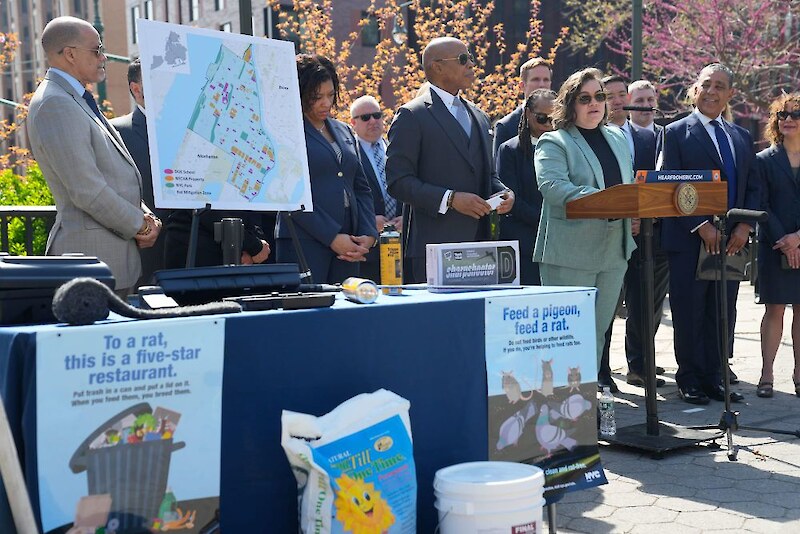 Eric Adams announces Kathleen Corradi as the city’s first ‘rat czar’ in 2023. (Michael Appleton/Mayoral Photography Office)Of course, New York has also been very creative. Remember the 2025 rat birth control pilot? The rat czar? Canine vigilante rat hunters? And Eric Adams’s (revolting) rat-drowning bucket pilot, when he was Brooklyn borough president?
But still, the city’s centuries-long battle to eradicate rats continues: Just this month, the New York Post reported rat sightings in the East Village were up 37 percent from last year. Business owners are still battling rodents. And some New Yorkers still really don’t wanna give up parking spots to the new on-street trash bins.
Eric Adams announces Kathleen Corradi as the city’s first ‘rat czar’ in 2023. (Michael Appleton/Mayoral Photography Office)
It all got me thinking, if my hometown is so good at the whole rat eradication thing, what could New Yorkers learn from them? Could New York City create a rat-free zone in the city, a rat-free neighborhood, a rat-free borough? And if push came to shove, would New Yorkers even want to eradicate our rats? They are, after all, our unofficial mascot. And unlike isolated New Zealand or Hawaii, New York doesn’t have as many delicate species that are threatened by them.
At our picnic table in Bryant Park, Shanahan sketched out a rudimentary map of Wellington—population 430,000—in crayon, pointing like a general at how conservationists were now moving the front line of the rat-free zone from Miramar, across the city, toward Zealandia. Zealandia is another Kiwi conservation win. After years of iterating on fence designs that could keep out all mammals, the 556-acre sanctuary found one that works. They removed 15 different invasive predators, held the line with a five-mile fence, and now the bird population—including kiwis—is booming, even beyond the confines of the sanctuary. Now when I visit my hometown, native birds like the Tūī, the Kākā and the Tīeke flock across the city, from the government buildings to my friends’ backyards.
“They’re going to catch up to the Zealandia fence,” Shanahan said, prodding at her map. “When we achieve that, imagine what could be possible for nature across our entire city—like, we’ve got Zealandia, the source of our biodiversity, and then we’ve got a landscape which is healthy and well and ready to accept it.”
Miramar, a neighborhood of about 20,000 people and 13 schools, is of course quite different from New York City. But like many parts of the city, it’s on a peninsula—which makes it more defendable against rats, according to James Willcocks, project manager of Predator Free Wellington, the group leading the charge. Thinking comparatively, places like Throggs Neck, Hunts Point, and the Rockaways come to mind, and why not even Greenpoint, and then the island of Manhattan?
“I would focus on the areas where you have a crack at being able to stop things getting back in. So if you get a proof of concept, you can look to scale from there,” Willcocks told me over a long distance phone call. “And maybe in some of those areas you can get that answer to the ultimate ‘why’ question very quickly. So in the Miramar Peninsula, native birds have increased by 136 percent in five years. They’re just going off the hook.”
Willcocks is talking about how, to kick off the project, he and his team had to go door to door in Miramar for six months, explaining “why” they wanted to put traps and bait stations in people’s backyards, that they then checked on weekly until the area was rat-free. Now, people chase him down the street to get their traps refreshed, he said. It’s been a long road for the conservationist, though. He said he hatched the plan in 2017, and spent until 2019 organizing and securing funding, before COVID-19 took them out of the field for seven weeks in 2020.
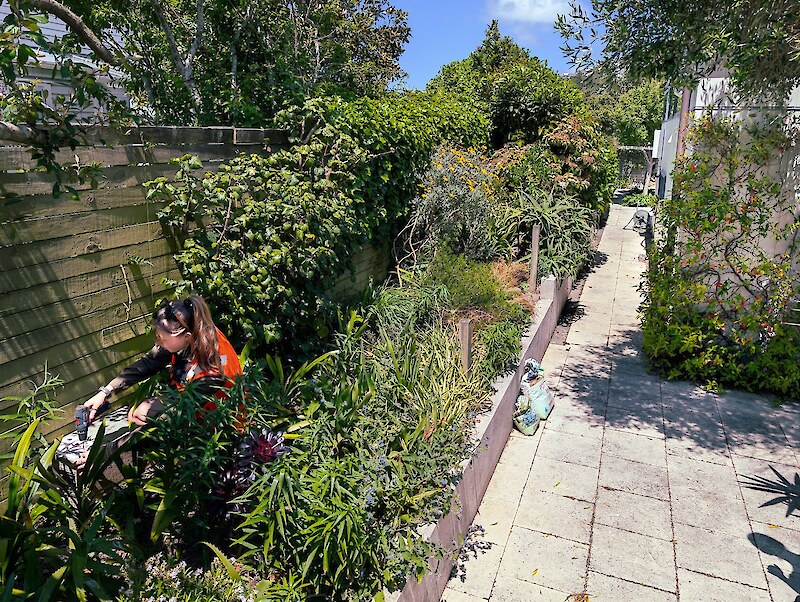 A Predator Free Wellington employee installs a trap in a Wellingtonian’s yard. Tim Sutton“That’s two rat breeding cycles, so that put us back to zero,” he said. “We lost all of our funding.” But he picked back up in 2021, and through trial and error, finally got Miramar rat free by 2024. “You know, you get your soul destroyed, you get broken, and then you go and do it again,” he said.
Now, the organization has 30 employees, thousands of volunteers, and a NZD$3.8 million annual budget, about three-quarters of which comes from central and local government—funding Willcocks says he can easily justify through the economic impact of not having rats chewing through wires, a decreased risk of zoonotic diseases, plus a “mini tourism boom” from researchers visiting to learn about the work. For interested municipal parties, Willcocks also said eradicating rats was quite cheap: NZD$2,800 per hectare (or 2.5 acres) for actively de-ratting, then about NZD$50 per hectare to maintain it rat-free. “What’s that? $25 U.S. dollars?”
The key elements that made Miramar successful as a starting point, he said, was it had a little bit of everything to test rat-elimination strategies on—bush, commerce, coastline—and some of the highest and lowest poverty levels in the city.
“Our work is very, very intense. We’re talking about placing 11 lethal devices—so 11 traps and bait stations—across every area the size of a rugby field, right across the Miramar Peninsula, and so we needed to figure out how we were going to get everyone on board.”
That meant getting buy-in, through thousands of one-on-one conversations, with neighbors from all walks of life—including negotiating access to New Zealand’s Black Power gang pads, and the properties of wealthy Kiwis who didn’t want to admit they had a problem. “For some people, it’s wanting to participate in some form of collective action that’s bigger than them. For some, it’s the birds. But others, maybe it’s not wanting the risk of having rats chewing through wires in their car,” Willcocks said.
They’re also in schools, where Kiwi kids now learn from an early age how to trap and kill rats—though it’s taught with respect for the rats, Shanahan said. “The rat killing is part of it… but the other thing we really try not to do is vilify the rats too much. These are creatures that, through no fault of their own, are causing havoc for our natural environment. But we should be treating them with the care, kindness, and respect that they deserve. Humane practices all the way.”
Secondly, said Willcocks, it’s finding an area that is “defendable” to prove you can do it at all. Being on a peninsula helps, though rats can swim—so volunteers also monitored the coastline. “Proving that it can be done on a small scale, is that critical thing,” he said.
“We’ve basically gone from the absurd to complete normalization in 10 years. That journey can go from seeming unachievable to a reality very, very quickly.”
At a nuts-and-bolts level, the organization uses Brodifacoum, a rat bait, in lockable bait stations in backyards and schools across the area, “so it’s very, very safe to pets and humans,” paired with a number of different traps, from the classic Victor rat trap to DOC 200s [a New Zealand-made humane trap]. They also have cameras across the area—one per hectare—and a full-time rodent dog, Rapu, who scours Miramar for rats with his handler Sally. “They’re basically Miramar locals out there combing all the hotspots and making sure that nothing gets back on the peninsula,” Willcocks said. However, he said the most important tool an municipality trying to achieve the same goal has is the cooperation of residents—in his case, the 20,000 neighbors who live in Miramar. Predator Free Wellington has a hotline—0800-NO-RATS—and staff respond within 12 hours of a rat sighting. “It’s almost like Ghostbusters,” Willcocks said. “And we’re trying to aim to be more responsive than your internet service provider, because that builds confidence in the system.”
Still—skepticism abounds from the Northern Hemisphere. The City’s Sanitation Department said they’re more focused on moving trash into rat-proof containers. “From DSNY’s perspective, we are not so much focused on eradication as we are on cutting off the food supply of rodents,” spokesperson Vincent Gragnani wrote in an email. To talk about eradication efforts, he referred us to the Health Department, which said its rat specialist is off this week.
When I note that we still have trash bags, and high density, and thousands of restaurants, and millions of people, many of whom are renters, Willcocks is undeterred. He said, nowadays, he spends some of his time advising other cities and islands about exactly this. And he’d be happy to speak with New Yorkers.
“It’s just an issue of scale,” he said. “So the reality is, yes, you can do it in New York. You’ve just got to change your thinking around this. First and foremost, Predator Free Wellington is a social movement. If you get a critical mass of people, like an entire city, working towards a goal together, then it’s phenomenal what you can achieve.”
Posted: 29 July 2026